


UNK joins national program sending student research to space
KEARNEY – Most college research projects are conducted in a campus laboratory. This one will occur 250 miles above Earth.
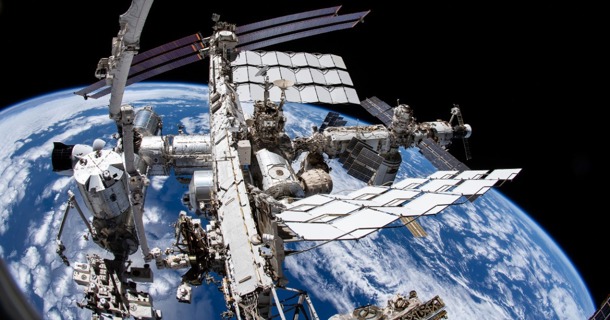
The University of Nebraska at Kearney has been selected to participate in the Student Spaceflight Experiments Program (SSEP), a nationally recognized STEM initiative that gives students the opportunity to design microgravity experiments for astronauts at the International Space Station.
In spring 2027, one UNK experiment will be launched into orbit aboard a SpaceX rocket. After its arrival at the space station, astronauts will conduct the research over the next four to six weeks before returning the project and data to Earth for analysis.
“The Student Spaceflight Experiments Program presents a pretty unique opportunity for our students,” said Joel Berrier, an associate professor and chair of UNK’s Department of Physics and Astronomy. “Not only can they design an experiment that will actually be flown to the International Space Station, but they also get to experience what the professional research process looks like, including writing a full proposal and having it evaluated by a review panel.”
Started in 2010, SSEP immerses students in authentic scientific research by challenging them to develop experiments that can be conducted in a weightless environment. Student teams submit formal proposals, mirroring the competitive process used by professional researchers seeking access to limited research opportunities.
This fall, UNK will host an open campus competition in which students work in teams to develop experiment ideas. The proposals will be reviewed by a panel of UNK faculty members, who will select three finalists. Those proposals will then advance to a national review process, where one experiment will ultimately be chosen to represent UNK aboard the International Space Station.
The competition will be open to students across campus, from freshmen through seniors. Faculty members plan to recruit participants through academic programs and student organizations in fields such as physics, astronomy, biology, chemistry and health sciences.
Students can design experiments in a wide range of scientific disciplines, including seed germination, crystal growth, chemical processes, microbiology, cell biology, food science and studies involving aquatic life. The central challenge is determining what physical, chemical or biological system might behave differently when gravity is effectively removed from the equation.
Berrier believes the program aligns perfectly with UNK's emphasis on hands-on learning.
“It presents a new way for us to provide experiential learning for students,” he said. “Creating something that will actually go into space is an extremely rare opportunity. There’s really no other way for students to experience something like that.”
The selection is particularly meaningful because only about 30 to 35 schools, colleges and universities participate in the program each year, according to Berrier, and UNK hasn’t been involved before. It also comes during the final years of the International Space Station, which NASA plans to retire at the end of the decade.
Funding for UNK's participation was secured through the Nebraska EPSCoR program, supported by the National Science Foundation.
In addition to the experiment competition, students from UNK Art and Design will have an opportunity to create mission patch designs that accompany the university's experiment into space and return as certified flown artifacts.
Following the mission, students involved in the selected project will continue the research by analyzing the returned data. They’re also invited to present their findings during a national conference at NASA’s Kennedy Space Center.
“We’re really excited about this opportunity,” Berrier said. “We hope it shines a spotlight on UNK and the incredible work our students are capable of doing.”
SSEP is a program of the National Center for Earth and Space Science Education and the Arthur C. Clarke Institute for Space Education. It was designed as a keystone initiative for national STEM education to help inspire America’s next generation of scientists and engineers.